
Sub-Total: $0.00
World and Wisdom: Building Better Practice Fields for Reality

I still remember seeing the film The Matrix in 1999.
At first, it felt like a science fiction action film with leather coats, sunglasses, and fight scenes that still hold up.
The Matrix (1999) movie poster
Two scenes lodged themselves in my mind.
- The first is when Morpheus explains the Matrix to Neo. The world Neo thinks he understands is not the world itself. It is a simulation convincing enough to be mistaken for reality.
- The second is when Trinity needs to fly a helicopter, but she was not an expert. She does not train. She simply downloads the knowledge, and seconds later, she is ready to operate the machine.
In a way, The Matrix was never just asking whether the world was real. It was asking a harder and more useful question: Can a simulation prepare us to act more wisely when reality finally arrives?
That is the question I have been working on ever since.
Purpose, Scope, and Objectives
Before any professional wargame or exercise begins, three things need to be clear: purpose, scope, and objectives.
- Purpose answers: Why are we doing this?
- Scope answers: How much of the problem are we trying to represent?
- Objectives answer: What do we want to learn, test, practice, or improve?
Wargames and Exercises Are Not the Same Thing
A wargame is a structured decision-making activity that places players in a simulated competition, crisis, or contested environment. Players make choices, the game responds, and the group explores consequences and possible outcomes.
An exercise is a structured practice event designed to test, train, or evaluate people, plans, processes, organizations, or capabilities in a simulated situation. Participants work through a scenario to see how well they coordinate, communicate, and perform against defined objectives.
Put simply: a wargame explores decisions and consequences. An exercise practices performance and coordination.
The World and the Wisdom
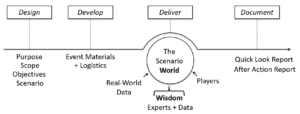
In my experience, two factors determine whether a professional wargame or exercise works: the world and the wisdom.
The World: Making Reality Playable
By world, I mean the curated reality and ground truth of the game: its terrain, systems, constraints, resources, and data that shape what players can actually do.
Layered into that world is the scenario. The scenario is the story of pressure. It gives the world motion. It explains what is happening, why it matters, who is involved, what is changing, and why players must act now.
If the world defines the operating environment, the scenario defines the situation inside it. It introduces the conflict, opportunity, or decision points that forces players to engage. For example:
- A seaport exists in the world. A cyberattack that slows seaport operations may be part of the scenario.
- A hospital exists in the world. A hurricane approaching the coast that inhibits road access to the hospital may be part of the scenario.
- A supply network exists in the world. A sudden fuel shortage that limits fuel delivery may be part of the scenario.
The world tells players what is possible. The scenario tells them that the clock is running.
The point of this is not to recreate all of reality. That would be deeply challenging as reality has too many sensory inputs. The point is to identify the parts of reality that matter most to the problem being explored, then organize them into a playable form.
When Analog Is Enough. Sometimes the playable world does not need a screen. A map, a few counters, a clear rule set, and a strong facilitation team can create a powerful decision-making environment. If the goal is to explore leadership, trust, or judgment under pressure, analog may not just be sufficient; it may be better. The abstraction strips away noise and forces players to focus on the choices that matter.
When Digital Matters. But some problems carry too much complexity to hold in the room. If the outcome depends on real supply chains, transportation capacity, infrastructure dependencies, timing relationships, or cascading effects, digital tools become essential. Not because digital is better but because some realities cannot be responsibly simplified. Oversimplified data can create a dangerous illusion: insights that feel precise but are not actually realistic.
A professional wargame or exercise becomes valuable when the design team defines the problem clearly, limits the scope intelligently with assumptions and artificialities, and builds a practice field that is detailed enough to matter. Not too broad. Not too narrow. Not so abstract that it loses realism. Not so detailed that it collapses under its own weight. That is proper scope.
That is where Morpheus’s description of the Matrix starts to matter. He describes a world that feels real because it is built from signals the mind can understand. A good wargame or exercise does something similar, but with a different purpose. It does not try to deceive the player into mistaking simulation for reality. It builds a focused version of reality so players can see, decide, and learn before the real world answers back.
The Wisdom: Turning Decisions Into Consequences
By wisdom, I mean the expertise and data that help determine what happens after players make a decision.
In an effective wargame or exercise, players should not simply make a choice and move on. The world needs to respond. Something has to tell them what happened, what changed, what failed, what improved, and what new situations they now face.
That response requires more than just information or data. It requires judgment.
- Today, that judgment often comes from experienced people in the room: facilitators, subject matter experts, adjudicators, or analysts who understand how a system is likely to behave.
- In the future, more of that expertise will be captured, cataloged, and made available at the moment of need. The knowledge that once lived only in someone’s head, notebook, or hard drive will increasingly be embedded into the game itself.
That is where the Trinity helicopter scene feels less like fantasy. She needed a capability, and the system delivered it instantly. Wargames and exercises may never be that simple, but they are moving in that direction: toward worlds where expertise can be summoned in real time, connected to the decision at hand, and used to help players understand the consequences of their choices.
The Future: When the Simulation Gets Smarter
The best games do not try to recreate the entire world; they are reductions of the physical world. They create a playable version, one clear enough for people to test choices, feel consequences, and practice decisions they may one day have to make for real. That playable world is about to become much more powerful.
- For the world, computer vision, scanning, immersive technology, and more efficient processing will make it easier to turn real spaces, objects, and into playable simulations without lots of labor upfront.
- For the wisdom, a digital player or robot will be able to see an analog board in the real world as much as we do but with access to far more data, memory, and pattern recognition than any single human player could hold at once.
As data becomes better organized and easier to access, AI agents will make specialized knowledge more present inside the game itself. But in a world flooded with uncurated data, true expertise becomes even more important, not less. The value will not come from having access to more information. It will come from knowing which information matters, how to interpret it, and how to apply it to the decision at hand.
The expert will no longer need to sit outside the exercise waiting to be consulted. In many cases, expertise will be built into the world, shaping what players see, what consequences they face, and what options they understand.
Before the Stakes Are Real
The future will blur the line between analog and digital. The future of wargaming will not be purely physical or purely digital. It will be playable and adaptive. Physical boards and digital twins, AI agents and human facilitators: immersive environments will increasingly work together.
That is the real value of wargaming and exercises:
- They turn data into a world.
- They turn expertise into consequence.
- They give people a place to practice before the stakes are no longer pretend.
When The Matrix came out in 1999, it felt like science fiction. Today, it feels like an early signal: the future will belong not just to those who can see the simulation, but to those who can design it wisely.