
Sub-Total: $0.00
The Robot Butler Finally Came Back
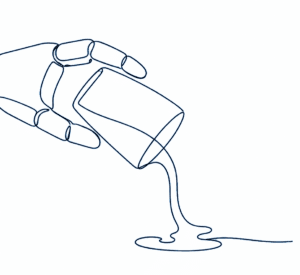
When I was a kid, I was convinced the future was going to arrive on treads, carrying a tray of drinks.
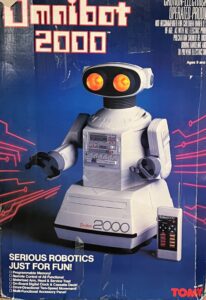
My childhood robot was the Tomy Omnibot 2000, a wonderfully optimistic 1980s vision of domestic robotics. It had a tray. The drinks rotated. You could pick them up with its arm. And, if memory serves, you could also spill them on the floor with great futuristic confidence. It was magic.
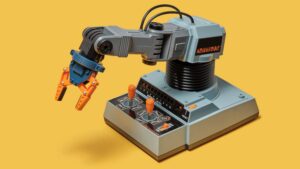
I also had a Radio Shack Armatron robot arm, which let you manually control mechanical movement with a kind of awkward precision that felt, at the time, like operating a space station cargo arm.
These toys were not just toys to me. They were invitations. They suggested that the physical world could be programmed, manipulated, and made playful. They were early hints that imagination, machines, and human agency could all sit at the same table.
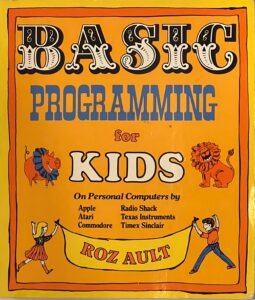
Around the same time, I was also drawn to programming. Not because I understood where it would lead, but because it felt like a secret language for making ideas real. You could type something into a machine and, if you got the logic right, something happened. A character moved. A screen changed. A little world came alive. My mother and I took BASIC courses at the local community college.
That was the hook.
Then, like many people, I drifted. Not away from imagination, but away from the technical skills that first opened the door. I did not keep programming as a core discipline. I did not become a roboticist. I did not stay fluent in the languages and tools that would have allowed me to keep building directly with machines.
Instead, my career moved toward game design, exercises, and scenario-based learning. At first, that might sound like a departure. But looking back, it was really a different expression of the same instinct.
Games are programmed worlds, even when there is no computer involved. A boardgame is a system of rules, pieces, terrain, incentives, constraints, and choices. A wargame is a model of reality made playable. An exercise is a temporary world where people can practice decisions before the consequences are real.
I may have stepped away from programming machines, but I never really stepped away from building worlds.
For years, the gap was obvious. I could imagine the experience. I could design the scenario. I could sketch the game mechanics. I could describe what the system should do. But turning that vision into working software, intelligent agents, or physical robotics required skills I had not maintained.
- It is one thing to say, “Wouldn’t it be interesting if a digital player could participate in this game?” It is another to actually build one.
- It is one thing to imagine an artificial coach, adversary, subject matter expert, or business expert joining a live discussion-based exercise. It is another to create something that can listen, reason, respond, and adapt in the room.
- It is one thing to look at a boardgame and imagine a robot that can see the pieces, interpret the state of play, and physically interact with the environment. It is another thing entirely to connect computer vision, language models, robotics, and game logic into something that works.
For most of my career, that distance between imagination and implementation was wide. Now, because of AI, it is narrowing.
That is the part that feels different. AI is not just another tool in the stack. It is becoming connective tissue. It can help translate intent into code. It can interpret images. It can reason over rules. It can help someone like me, whose career moved toward design and facilitation rather than technical implementation, begin to build again.
Not alone. Not magically. Not perfectly. But enough to close the gap.
The opportunity is not simply to make games more digital. The opportunity is to make our learning environments more alive and more immersive.
- Imagine an AI agent in a discussion-based exercise that can play the role of a skeptical commander, a logistics expert, a cyber adversary, a policy advisor, or a business investor in a Shark Tank-style event. It could pressure-check assumptions in real time. It could ask the uncomfortable question no one else wants to ask. It could help teams rehearse under friction.
- Imagine trained AI experts that are always available to deploy into a session: what I have been calling a “two-way master class.” Not just a static lesson, but an expert that can teach, listen, adapt, and learn from the interaction with you.
- Now imagine those agents stepping out of the screen. A red robot, a blue robot, and a white robot around a wargame table. Each able to observe the board, understand the current state, represent a perspective, and maybe even move a piece. Computer vision watches the game. The agent interprets what changed. The robot becomes a physical presence in the room.
That idea brings me right back to my Omnibot. Only this time, the robot is not just carrying drinks in circles and spilling them on the floor. It is participating in the game.

The funny thing about childhood passions is that they do not always disappear. Sometimes they go dormant. Sometimes they wait decades for the world to catch up, or for the tools to become accessible enough that the old dream can find a new form.
Programming, robotics, game design, and physical play no longer feel like separate roads. They are converging. The robot butler, the the scenario, and the code are all starting to point toward the same future.
And maybe that is the lesson. We do not always return to our childhood passions by going backward. Sometimes we return to them by carrying everything we learned along the way.
I did not become the programmer or roboticist I imagined as a kid. I became a designer of playable worlds. Now AI may let me build the bridge between those worlds and the machines I once dreamed about.
And if the first robot still spills the drink? Honestly, that feels on brand. The future has always been a little messy at first.