
Sub-Total: $0.00
Worlds That Aren’t, and What They Teach Us
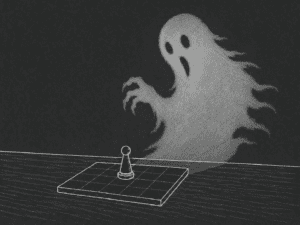
There is a strange comfort in being scared by something we know is not real.
A horror movie can make us grip the armrest, hold our breath, and silently question every life choice that led us to watch it alone in the dark. The Sixth Sense was the movie that did this for me.
A dream can feel so vivid that we wake up with our heart racing, still carrying the emotional residue of something that never actually happened.
Then, after a few seconds, we remind ourselves: it was only a movie. It was only a dream.
That phrase does a lot of work. It does not mean the experience was meaningless. The fear was real. The tension was real. The emotional response was real. What was not real was the danger, and that distinction matters.
Movies, dreams, like games and exercises all create temporary worlds where we can feel something deeply without suffering the full consequences of reality. They give us a protected space to experience fear, surprise, pressure, uncertainty, failure, courage, and choice.
In other words, they let us rehearse being human.
That is why scary movies work. We know, at some level, that we are safe. The monster cannot actually climb out of the screen. Probably. The creepy doll is not really in the hallway. Hopefully. The artificial space gives us permission to engage while the real world remains intact.
Games and exercises do something similar, especially in professional settings. They allow teams to step into a version of the future, a crisis, a disruption, or a decision point before it becomes real. The scenario may be fictional, but the conversations are not. The stress may be simulated, but the insights are real. The choices may happen inside the scenario world, and the patterns they reveal often show up later in the real world where the stakes are higher.
That is the value of a practice space.
We do not run exercises because we believe the scenario will unfold exactly as written. We run them because they help people encounter uncertainty before uncertainty arrives without our permission. They help organizations discover gaps, test assumptions, build muscle memory, and surface uncomfortable truths while there is still time to act and plan and practice.
A good exercise, like a good movie or a vivid dream, creates immersion. For a little while, people accept the world in front of them. They make decisions inside it. They feel pressure from it. They react to it. Then it ends.
And when it ends, everyone can step back and say: that was only a scenario, and the lessons go beyond the “only” space. The lesson that a team did not know who had decision authority is real. The discovery that communication pathways break under pressure is real. The realization that a plan looks elegant on paper but collapses when humans have to use it is very real.
The world was constructed. The learning was earned.
That is the interesting space between perception and reality. We often treat perception as something less than real, as if what we feel, notice, or imagine is secondary to what physically happens. But perception shapes behavior. Behavior shapes outcomes. And sometimes the thing that is “not real” is exactly what allows us to see reality more clearly.
- A movie can show us what fear feels like.
- A dream can reveal what we are avoiding.
- A game or exercise can expose how we make choices and show an organization what it is ready for, and what it is not.
These spaces are not escapes from reality. At their best, they are carefully designed returns to it.
Because when the lights come back on, the dream fades, and the game board is cleared, we bring something back with us: awareness, humility, and maybe a little more readiness. It was only a movie. It was only a dream. It was only a game.
What we carry back from those imagined worlds may be exactly what prepares us for the real one.