
Sub-Total: $0.00
Red, Blue, and the Space Between: What BTS’s “Normal” Says About Life’s Complexity
I have always loved deep lyrics. The kind that seem simple on the first listen, but keep unfolding the longer you sit with them. The best songs can feel like small philosophical machines. A few lines, a melody, and suddenly you are thinking about identity, pressure, storytelling, and how we make sense of the world.
That is one reason BTS is worth a listen, even if many of their songs move between Korean and English and some of the meaning may not land immediately for every listener. Their lyrics have always carried complexity, and over time you can hear the maturity of the band in how they write about identity, pressure, ambition, exhaustion, and the cost of being seen.
That is what pulled me into BTS’s new song “Normal.”
For anyone who has somehow missed the global phenomenon, BTS is a seven-member South Korean group that debuted in June 2013 and grew from a hip-hop-rooted act into one of the most influential pop groups in the world. The members are RM, Jin, SUGA, j-hope, Jimin, V, and Jung Kook (BIGHIT MUSIC, “BTS Profile”). Across studio albums, EPs, Japanese releases, compilations, solo work, and live projects, their body of music has become both massive and unusually personal.
Their reach is global not just because of sales, streams, or stadiums, but because their songs often return to deeply human themes. Identity, pressure, self-doubt, ambition, love, exhaustion, and the cost of being seen.
That context matters when listening to “Normal.”
That has a deeper resonance if you know the origin of BTS’s name. Bangtan Sonyeondan is often translated as “Bulletproof Boy Scouts,” a name built around the idea of resisting the criticism, expectations, and pressure aimed at young people. In English, BTS has also been associated with “Beyond the Scene,” reflecting growth beyond that original frame (BIGHIT MUSIC, “BTS Profile”).
In “Normal,” that idea comes back in a more mature, complicated way.
Lyric callout
Heavy is the head when you chasin’ true
Will you color me red?
Will you color me blue?
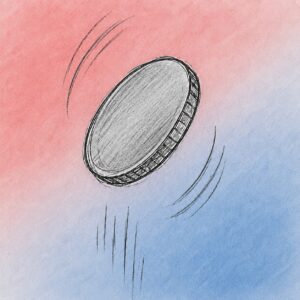
Two sides of a coin, and they both ain’t true
Is it different for me?
Is it different for you?
I am sure different people will hear different things in those lyrics. That is one reason I like them as deep lyrics leave room for the listener.
What I hear is a question about being forced into a category. Are we seen as we are, or are we colored by what others need us to be?
- “Heavy is the head when you chasin’ true” reflects the pressure and hidden burden that come with global fame
- “Red” and “blue” represent the extreme, black-and-white labels people may put on them
- “Two sides of the coin” suggest whichever version may be selected, neither image fully captures who they really are

There also may also be a deeper Korean resonance. The South Korean flag, the Taegeukgi, places a red and blue Taegeuk at its center. The blue portion is associated with yin, the red portion with yang, and the symbol represents harmony between opposing cosmic forces (Ministry of the Interior and Safety, “The National Flag: Taegeukgi”).
That is also where my mind goes as someone who thinks a lot about games.
In wargaming, red and blue are useful. A red team as an adversary and blue team as friendly help us model conflict, assign roles, and move play forward. The simplification matters. Without it, the game would collapse under the weight of reality.
But the danger comes when we forget that red and blue are design choices, not reality. Real actors have mixed motives. Allies can have competing interests. Enemies can share common fears. The “right” move may have second- and third-order effects. A decision that seems obvious in one turn can look very different after the world changes around it.
The same is true in films. Stories often begin with clear roles. The hero. The mentor. The villain. The monster. The outsider. The chosen one. Those shortcuts help the audience enter the world quickly. They give us something to hold onto.
But good stories move beyond those easy categories.
A game becomes more interesting when the choices are not obvious. When the “enemy” has a reason. When the right move has a cost. When winning the game does not necessarily mean understanding the world. This type of game is really difficult to build, thus we use assumptions to simplify the mechanics.
A film becomes more powerful when the hero is flawed, the villain is wounded, and the monster may be the only character telling the truth. The story gets richer when we realize the labels were only an entry point, not the whole picture.
That is where the real lesson sits.
Categories are useful tools, but they are not the truth. They help us begin to understand the world, but they can also trap us if we forget they are abstractions. The map is not the terrain. The game board is not the war. The character archetype is not the whole person.
Life is not red or blue. It is shifting, layered, often contradictory.
Categories help us play the game, tell the story, and make sense of the world. But they are only the starting point. The real work begins when we stop treating the category as the answer and start treating it as the opening question.
Maybe “normal” is not a fixed state at all. Maybe it is just the name we give to whatever complexity we have learned to tolerate.