
Sub-Total: $0.00
What Five Yen Can Teach Us About the Choices We Make
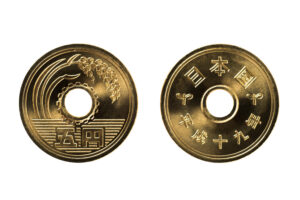
This past month I attended a wedding where the couple had custom rings modeled after the Japanese 5-yen coin. During the ceremony, the Shinto priest explained the connection between the rings and the Japanese word go-en which means “good connection.” The two words are are homophones, words that sound identical but have different meanings. Both are both pronounced go-en, giving the coin its association with meaningful relationships and good fortune.
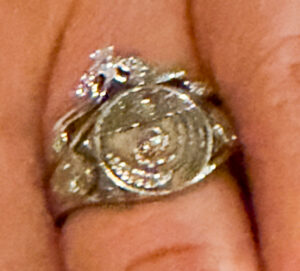
A 5-yen coin as a wedding ring
That wordplay is one reason 5-yen coins are commonly given as offerings at Shinto shrines. The coin has become associated with hoping for good connections in life. That makes it a pretty remarkable model for a wedding ring.
It also got me thinking about karma. In the West, we often turn karma into a kind of cosmic scorecard: do something bad and eventually something bad happens to you. But I find the broader idea much more interesting. Our actions matter because they create consequences. One decision changes the conditions for the next decision. What we do moves outward and intersects with other people.
That feels closely related to go-en. The two ideas are not the same, but they fit together nicely. One asks us to notice the connections in our lives. The other asks us to think about what we do with them.
Think about everything that has to happen before two people eventually stand together at a wedding. Someone accepts an invitation. Someone moves. Someone takes a job. Someone introduces two friends. Someone starts a conversation. Someone says yes. Thousands of choices, accidents, relationships, and decisions slowly intersect until, looking backward, they almost seem inevitable.
But they weren’t; they were moves.
I have written before about how games give us models of the world in which we can predict, act, observe what happens, and move again in Games as Models of the World. Life obviously isn’t a board game, but the same basic idea applies. Every move changes the world slightly. It creates new possibilities for ourselves and sometimes for people we haven’t even met yet.
There is another part of the 5-yen coin I like: the hole in its center. It makes me think about the Japanese idea of ma, the intentional space between things. I wrote about that in Finding Ma: The Art of Space in Japan (and Why You Need It Too). Two people remain two people. The important thing is what develops in the space between them.
Maybe that is why I liked these wedding rings so much. They took an everyday object worth almost nothing and transformed it into an artifact carrying an enormous amount of meaning. A 5-yen coin becomes a symbol of connection. That symbol becomes a wedding ring. And now that ring will accumulate experiences, memories, decisions, and stories of its own.
That may also be a useful way to think about karma. Not as the universe keeping score, but as a reminder that our actions rarely stop with us. They travel outward. They create connections. They alter what becomes possible next. We don’t control every person who enters our lives or every circumstance that puts someone in our path, but we do control our next move.
Sometimes we are lucky enough to discover that something small we did mattered to someone else. A comment we barely remember. An invitation. A kindness. A moment of encouragement that stayed with them long after it passed for us.
Most of the time, we never see the full path of those actions. They move outward into other people’s lives, becoming part of stories we may know nothing about. Our choices keep traveling.
And every once in a while, one of those connections may find its way back to us, reminding us that even the smallest move can become part of something much larger.