
Sub-Total: $0.00
Games as Models of the World
Jeff Hawkins’s A Thousand Brains helped re-emphasize for me why games have persisted as useful models of the world and its challenges, whether real or abstract.
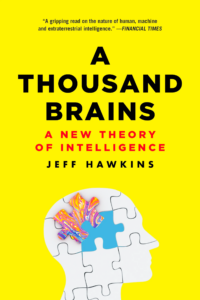
He describes how the brain learns a model of the world, where objects are and how they move. We are not born already understanding that model. We know nothing when we are born. We construct our understanding through experience.
Hawkins argues that the brain continually predicts what it will experience next. The predictive model never stops. It continually verifies the model is accurate. When the world moves or the inputs change, we react. We move.
That movement is essential. True learning requires movement + exploration. Games do this.
We learn an object by looking at it, touching it, and moving around it. Hawkins describes this as sensorimotor learning. The brain connects each feature with its location relative to the object. Look, feel, do = sensory motor learning. We often must move to discover. The answer is not fixed.
Games turn that principle into a repeatable experience.
A chessboard provides a model of locations, allowable movements, and relationships. A role-playing game creates a fantasy world with its own geography, characters, rules, and consequences. A wargame represents a strategic environment shaped by competing objectives and incomplete information.
In each case, the game gives us a place to act. Achieving goals = movement. Every move generates new information. Players predict what might happen, act on that prediction, observe the result, and adjust their understanding.
Reference Frames
Hawkins argues that memory is a series of reference frames. These frames organize information by location and relationship. They function like x, y, z coordinates, map coordinates where location matters.
Grid cells help establish a reference frame. Place cells help identify our position within it. Head-direction cells help establish our orientation. Together, they allow us to locate ourselves and navigate an environment.
But reference frames are not limited to physical spaces. Reference frames work for the physical world like a map of a town, but also for concepts, like a fantasy world. We can build models of politics, corporate life, mathematics, stories, and strategic problems. These models have different dimensions, but each must remain internally consistent.
Knowledge of context is in reference frames. Facts become actionable when we understand where they belong and how they relate to everything around them.
This is also what games do. They organize information inside a shared reference frame. The rules define what exists, the relationships among the elements, and the actions that are possible. The player learns where they are, what they can do, and how the world responds.
Games create frames + a place for learning.
The Method of Loci
The idea of organizing memory spatially is ancient. The classical “method of loci,” now commonly called the “memory palace,” was traditionally attributed to the Greek poet Simonides of Ceos.
According to the story, Simonides left a banquet shortly before the building collapsed. The victims could not be identified, but Simonides remembered where each guest had been seated. By mentally reconstructing their locations around the table, he was able to identify them.
Greek and Roman orators developed this insight into a deliberate method for remembering speeches. They imagined placing ideas or symbols in particular locations throughout a familiar house. To retrieve the information, they mentally walked through the house, visiting each location in sequence. Cicero described the method in De Oratore, while Quintilian later provided a detailed account in Institutio Oratoria.
The memory palace turns abstract information into something spatial. Ideas are no longer disconnected facts. They have positions, relationships, and a path connecting them.
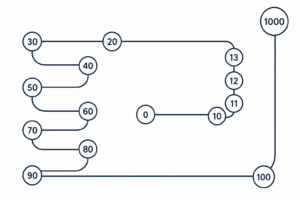
The number frame that evolved in my memory when I was very young
When I was very young, I created a map of numbers in my head that I can still visualize. It looks a little like the racetrack layout of a Chutes and Ladders board. The map gave abstract numbers a physical space, with each number occupying a specific location. It even has turns where maybe I had paused in my learning before I learned more advanced numbers. Years later, when I learned French numbers in high school, I immediately placed them within the same mental map. I can still see this mapping in my mind.
The method of loci, my number map, and Hawkins’s theory of reference frames share a compelling principle: abstract knowledge becomes easier to navigate when we give it a place. I listen to many audiobooks while driving, and I often recall a passage alongside an image of the state or road where I first heard it. The book’s ideas become connected to my physical location, as if the journey itself provides a map for the memory.
Games extend this principle by creating shared spaces for memory and learning. A board, map, timeline, character sheet, or imagined world gives information somewhere to exist. Players remember facts through their relationships to locations, objects, and possible actions.
In this sense, a game can become a shared memory palace: a structured world in which we place knowledge, move through it, and retrieve it through play.
Thinking as Movement
Hawkins’s theory also suggests that thinking is not entirely separate from movement. Thinking is a form of movement, and we must activate locations in reference frames.
We can mentally travel through a familiar house, move along a timeline, explore a map of numbers, or examine the branches of a possible future. A timeline is a one-dimensional reference frame to order events. Tactical and strategic games similarly allow us to move through a problem at different levels.
Learning creates new reference frames. As we learn, our brain finds a way for us to effectively recall this new knowledge and orient it in a away that’s useful to us. Experts can help us align ourselves with an existing frame when we are lost or confused with new concepts.
This may help explain why games have endured as learning tools. They do not simply present information. They give us somewhere to put that information and something to do with it.
Games also allow us to practice repeatedly without merely repeating an answer. Each attempt can introduce a different decision, strategy, perspective, or result. We return to the model, test it again, and refine what we know.
The world moves, changes inputs, we react. We move.
Games persist because they let us practice that movement. They create models of physical, social, and imagined worlds in which we can predict, act, and learn.
The rules create the frame. The player moves through it. Each playthrough gives us another chance to improve the model we carry back into the real world.