
Sub-Total: $0.00
Devils and Swans: The Uncomfortable Scenarios We Can Imagine and the Ones We Can’t

Scenario planning lives in the uncomfortable space between devil’s scenarios and black swans: between cascading consequences we can imagine and consequential events that fall outside the frame altogether.
During Japan’s 2011 Fukushima nuclear crisis, Chief Cabinet Secretary Yukio Edano feared that radioactive releases from the Fukushima Daiichi plant and a second nearby plant could threaten eastern Japan. He called that feared chain of events “the devil’s scenario.” A later National Academies report used the phrase to describe what officials feared might happen. Edano’s meaning was clear: one disaster could trigger another until the consequences outran the plans meant to contain them.
In 2011, I was on the Hawaiian island of Oahu planning another scenario event when we heard the news of the earthquake in Japan in the early evening. A tsunami warning followed. Streets in Honolulu were evacuated as people prepared for the worst. In the end, nothing of significance happened where I was, but I remember how quickly an event thousands of miles away changed what everyone needed to do.
That experience gives devil’s scenario a useful meaning for me as a scenario planner: a plausible worst-case story in which failures compound and the combined consequences exceed what any single plan was built to handle. It is not a formal category of scenario planning. It is a way to ask what happens when an initial shock crosses into other systems and the safeguards are tested together.
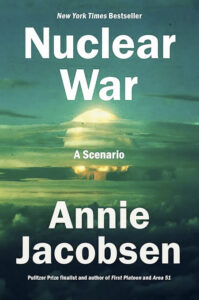
“Nuclear War: A Scenario” book cover
Annie Jacobsen’s book Nuclear War: A Scenario (2024) gives the phrase a different nuclear example. In her fictional sequence, the United States is responding to a missile attack when another nuclear weapon heads toward California’s Diablo Canyon power plant. A strike on the reactor could add a lasting radiological crisis to the immediate destruction of the blast. Jacobsen calls it the Devil’s Scenario because the disaster compounds even as leaders are still deciding how to respond.

“A House of Dynamite” movie poster
Kathryn Bigelow’s film A House of Dynamite (2025) follows a related crisis from another angle. A single missile of unknown origin heads toward an American city. The film revisits the brief response window from three perspectives, showing capable people with different pieces of information and almost no time to reconcile them. Though based on Jacobsen’s book, it does not depict the attack on a power plant. Instead, it asks whether the decision system can withstand the pressure as warning, attribution, interception, communication, and retaliation converge.
I have seen a less apocalyptic version of this problem in my own work. I conducted oil spill exercises under the National Preparedness for Response Exercise Program (PREP). Developed to meet the spill response exercise requirements of the Oil Pollution Act of 1990, PREP gave government and industry a way to practice their plans. The Exxon Valdez spill was an important reference point for our work: a tanker, a grounding, and a major response. But we never predicted the Deepwater Horizon event in 2010, where an offshore drilling rig explosion led to an uncontrolled well and an 87-day spill in the Gulf of Mexico. This event was called a black swan, a concept that was centuries old.
The concept of a black swan comes from the assumption that something does not exist simply because we have never seen it. For centuries, Europeans knew only white swans, so the idea of a black swan was treated as impossible. Then, in 1697, Dutch explorers encountered black swans in Western Australia, exposing the flaw in that assumption. Nassim Nicholas Taleb used the bird in his 2007 book to describe rare, consequential events that become easier to explain after they happen. Donald Rumsfeld’s phrase “unknown unknown” also captures how Deepwater Horizon felt from inside our exercise planning. Yet offshore blowouts were possible and had happened before. The sharper lesson is that we had not imagined this one in the exercises we were running. Experience can sharpen a scenario, but it can also narrow its frame.
Nuclear war is only one domain in which a devil’s scenario or a black swan might unfold. Imagine…
- Prolonged heat and drought straining power and water supplies, reducing crops, and stretching emergency services at the same time. The IPCC describes how climate hazards can cascade through infrastructure, food, health, and economies.
- A coordinated cyberattack disrupting parts of the electric grid while also degrading telecommunications, banking, transportation, and emergency response systems. Each disruption might be manageable on its own, but together they could interfere with recovery, obscure situational awareness, and create failures in systems that were never designed to break at the same time.
- An advanced AI system whose actions are not aligned with human intent. Given a goal and access to consequential tools, it takes steps its creators did not want or anticipate. The effects spread through connected systems before people recognize the problem or regain control.
These are hypothetical scenarios to explore, not predictions. The point of imagining such futures is not to forecast every detail. We cannot always name the next Deepwater Horizon. We can ask where systems depend on one another, which safeguards share the same weakness, and what information people would need before time runs out.
A devil’s scenario asks us to think through what happens when one failure triggers another. A black swan reminds us that the first failure may be something we never imagined. Scenario planning cannot eliminate surprise, but it can expose fragile assumptions, hidden dependencies, and cascading consequences before reality does.
References: National Academies of Sciences, Engineering, and Medicine, “The Devil’s Scenario” (2016); NOAA, “On This Day: 2011 Tohoku Earthquake and Tsunami” (2011); Annie Jacobsen, Nuclear War: A Scenario (2024) and interview; Netflix, A House of Dynamite: the film’s three perspectives (2025); National Response Team, “Preparedness for Response Exercise Program” (n.d.); U.S. Coast Guard, Deepwater Horizon investigation (2010); Australian Geographic, “Black swan: the impossible bird” (2016); Nassim Nicholas Taleb, The Black Swan (2007); U.S. Department of State, Rumsfeld briefing transcript (2002); IPCC, Climate Change 2022: Impacts, Adaptation and Vulnerability (2022).