
Sub-Total: $0.00
Side A, Side B, and 150 Years of Good Engineering
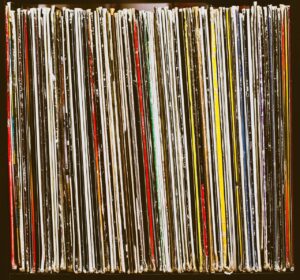
Stack of old vinyl records. closeup
Every January, right after the noise of New Year’s fades, I find myself doing the same quiet ritual we all do; looking backward to see what held up, and forward to see what might actually be worth improving.
Over the past few years, I began to much more fully appreciate the technological power of music on vinyl. Not in a curated, influencer way. In a far less impressive way. A box of my grandmother’s records. A turntable and receiver from the 1990s. Nothing smart. Nothing connected. Just a couple of cables and a power switch. I plugged it in and boom; the room filled with incredible sound.
No digital tracking. No algorithm trying to guess my mood. No end-of-year “wrap” telling me who or how old I am based on listening habits. Just me, a machine, and music played in the exact order the artist decided it should be heard.
Side A. Pause. Flip. Side B.
It felt less like nostalgia and more like rediscovering a forgotten superpower. Which got me thinking about how many technologies we casually label as “old” are actually just… finished. Complete. Solved. And that thought led me back to the Victorians of the late 1800s.
Every generation believes it lives at the peak of innovation. The Victorians were no different. Steam, steel, electricity, wires stretched across continents; they were certain the future had arrived. They were right. Just not in the way they expected.
Some of their technologies did not just survive. They quietly became the bones of the modern world.
Electricity
Electricity is not a product; it is a condition.
At its core, it is simply electrons being politely encouraged to move in a particular direction. The Victorians figured that out, and we have been remixing the delivery ever since. Coal, hydro, nuclear, solar, wind; same electrons.
What makes electricity endure is that it scales infinitely and complains very little. You can power a telegraph key or a data center with the same idea. Fashion changes. Physics does not.
Vinyl Records
Vinyl is sound made physical.
A groove carved into plastic captures vibration; a needle retraces it and brings motion back to life (this technology still amazes me!). No compression. You can literally see the music spiraling inward.
Vinyl survives not because it is nostalgic, but because it is honest. It works without updates, passwords, or the cloud. When everything else disappears, the needle can still drop.
Telegraphy
The telegraph reduced language to rhythm.
Dots and dashes are are efficient. Information becomes timing. Timing becomes meaning. Strip away the interface and you are left with signal.
And you may think this technology is certainly gone, but the idea never went away. Today we bury it under emojis and bandwidth.
Photographic Film
Film is memory captured chemically.
Light hits a surface and leaves evidence it was there. No battery required. Just photons and patience.
Yes, digital cameras won the convenience war, but film quietly won the archival one. Centuries later, a negative can still be held up to the light and say, “Yes. This happened.”
Sewing Machines
The sewing machine is a masterclass in restraint.
It does one thing, extraordinarily well, forever. It automates a human motion without replacing the human. No connectivity required.
Clothing still exists. So does the machine.
The Pattern the Victorians Got Right
The technologies that lasted were not clever; they were foundational because they:
- Solved real, recurring problems
- Could be explained simply
- Improved slowly instead of reinventing themselves loudly
They were infrastructure, not features.
So What Will Survive From Our Era?
Not the apps. Not the interfaces. The layers underneath.
A hundred years from now, we will still recognize:
- Electric grids, just cleaner and smarter
- Energy storage, because tomorrow still matters
- Recorded data, in forms we have not named yet
- Light-based communication, because photons beat copper
- Automation, quietly doing the dull, dangerous, or precise work
The sewing machine did not vanish; it evolved into a factory. The telegraph did not die; it learned to whisper at the speed of light.
What Probably Does Not Make It
A quick moment of realism:
- Platforms built on attention rather than utility
- Tools that stop working when the network glitches
- Hardware chained to subscriptions
- Anything that mistakes novelty for necessity
History is unkind to tech that needs constant applause.
The Quiet Lesson
Victorian engineers built as if they would not be around to explain themselves. Modern technology often assumes the opposite.
The tools that last are not the ones that shout the loudest; they are the ones that still make sense when no one is around to update them.
Final thought: If someone dug up your favorite technology in 2126, would it still work, or would it ask them to accept new terms and conditions? That is usually the tell.