
Sub-Total: $0.00
If You Know, You Know

Why discovery, authenticity, and shared experiences are becoming more valuable in an increasingly polished world.
There was a time when advertising focused heavily on what a product could do and how much it cost. Print advertisements were often dense with technical specifications, detailed illustrations, performance comparisons, and promises of savings. A car advertisement might explain horsepower and fuel efficiency. A computer advertisement might list processing speed, memory, and storage. Household products competed on price, durability, and convenience.
The underlying message was straightforward: here’s what we’re selling, why it’s better, and why it’s worth your money.

1970s Technics record player advertisement
Those details still matter. People want products that work, deliver value, and solve problems. But over time, marketers increasingly emphasized something less tangible: how a brand makes us feel.
Advertising became more aspirational. Rather than simply describing a product, companies associated their brands with identity, adventure, creativity, achievement, and belonging. The goal was no longer just to convince someone that a product was better, but to make them feel that the brand represented something they wanted to be part of.
Now another shift may be underway.
As more content becomes professionally produced, algorithmically distributed, and increasingly generated by artificial intelligence, even beautiful, emotionally compelling marketing can begin to feel interchangeable.
Instead, people seem increasingly interested in experiences they can discover, personalize, and share. A small gathering can sometimes create more loyalty than an expensive advertising campaign. A limited-edition collectible can mean more than a widely available luxury product. A recommendation from a friend may carry more weight than the most carefully crafted commercial.
The progression is interesting. We’ve moved from explaining what a product does, to communicating how a brand makes us feel, to creating experiences that give people something to feel, remember, and share. These approaches have always overlapped, but the emphasis is changing. The internet has a phrase for this: If you know, you know.
But I think there’s another dimension to the expression. Part of the fun of knowing something special is introducing it to someone else. You share a favorite place, an obscure band, a hidden feature in a game, or a particular way of ordering food. Now they know, too.
The experience becomes something you have in common.
The original secret door
The idea of discovering something special through shared knowledge is hardly new.
During American Prohibition, from 1920 to 1933, illegal drinking establishments known as speakeasies flourished. But the expression itself is older. According to the Online Etymology Dictionary(opens in new tab), the term appeared in American usage by 1889, with related expressions appearing earlier.
The name reflected the practice of speaking quietly about an illicit establishment to avoid attracting unwanted attention from authorities or neighbors.

Historical reference: Speakeasy patrons in New York, 1933. Margaret Bourke-White photographed the city’s nightlife near the end of Prohibition. See TIME’s archival photo essay at https://time.com/3613626/prohibition-photos-inside-the-speakeasies-of-new-york-in-1933/
Popular culture has given us the familiar image of the speakeasy: an unmarked door, a discreet knock, a whispered password, and a hidden room filled with music and conversation. Not every historical speakeasy operated this way. The secret-door mythology owes something to Hollywood, but its appeal is easy to understand.
The experience begins before you enter: Finding the location, understanding how to gain access, and discovering what’s inside become part of the story. The visitor is no longer simply a customer. They’re a participant.
There’s something about finding a hidden entrance that reminds me of my earlier post, Every Portal Changes the Rules(opens in new tab). Like Lucy discovering Narnia through a wardrobe, the thrill isn’t simply finding the doorway. It’s discovering the world beyond it, learning its rules, and eventually introducing others to it.
Modern speakeasy-inspired bars recreate that sense of discovery, even though selling alcohol is perfectly legal. The secrecy becomes theatrical rather than necessary, but the experience can still feel special.
And when you discover a place like that, what’s the first thing you want to do? Tell someone you think would appreciate it.
The secret menu: belonging in plain sight
You don’t need a hidden door or exclusive invitation to experience the appeal of insider knowledge; sometimes all you need is to know how to order a hamburger.

An In-N-Out order with an Animal Style burger on the right
I’ve written previously about the secret menu(opens in new tab) at In-N-Out Burger, where customers can order variations such as Animal Style and Protein Style that aren’t prominently featured on the standard menu. The company even acknowledges its not-so-secret menu(opens in new tab) on its website. Animal Style dates back to 1961, when the company began preparing burgers that way in response to customer requests.
What makes this interesting isn’t just the food. It’s the social experience surrounding it. Someone introduces you to a particular way of ordering. You try it, develop your own preference, and eventually pass that knowledge along to someone else. Suddenly, you’re no longer simply ordering from a menu. You’re participating in a tradition. The secret becomes a conversation.
This is an important distinction. In-N-Out doesn’t need to exclude people to make them feel like insiders. The appeal comes from discovery, customization, and sharing something that might otherwise go unnoticed.
That’s a powerful idea for anyone designing products or experiences. Belonging doesn’t always require exclusivity. Sometimes it simply requires giving people something worth discovering and sharing.
If you know, you know
The expression if you know, you know, often shortened to IYKYK, captures that feeling of shared understanding.
Its precise origin isn’t tied to a single documented creator. The expression existed conversationally before becoming internet shorthand and grew more visible online during the 2010s. Rapper Pusha T brought additional attention to it with his 2018 song “If You Know You Know” from the album Daytona. Today, IYKYK appears across social media, often accompanying photographs, references, or experiences whose meaning isn’t immediately obvious to everyone.
The expression creates an interesting social dynamic. People who recognize the reference feel an immediate connection. Those who don’t may become curious enough to investigate.
Unlike traditional advertising, which generally tries to explain everything, IYKYK leaves something unexplained, but it doesn’t have to be an exclusionary statement. One of the pleasures of discovering something is becoming the person who introduces someone else to it. Think about sharing a favorite obscure movie, bringing a friend to a restaurant you love, or introducing someone to music that has been part of your life for years.
Their enthusiasm can renew your own appreciation. The knowledge becomes more valuable when it’s shared, not less. Perhaps the most interesting part of IYKYK is the moment when someone moves from not knowing to knowing, and then wants to bring someone else along.
The collectible becomes the experience
Collectors understand this dynamic particularly well.
Consider limited-edition sneaker releases, often called drops. A new pair of shoes can generate extraordinary anticipation long before it becomes available. Enthusiasts follow designers, study release calendars, discuss collaborations, and exchange information about where a particular edition might appear. The shoes themselves may be beautifully designed, but the surrounding experience creates another kind of value.
The pursuit becomes part of the story.
Nike has institutionalized this approach through its SNKRS platform(opens in new tab), which offers exclusive product releases and invitation-based access. Its SNKRS Link(opens in new tab) program can use special links and QR codes shared through artists, athletes, and creative partners to provide access to selected drops. A product launch becomes a discovery process rather than simply a transaction.
The same phenomenon appears in vinyl records, trading cards, watches, vintage video games, and signed memorabilia. A collector may already own a perfectly functional version of an object, yet pursue another because of its history, rarity, provenance, or association with a particular moment. The physical item becomes an artifact of participation.

Vintage dress shoes for sale in Tokyo
I explored a similar idea in What Five Yen Can Teach Us About the Choices We Make(opens in new tab), where an ordinary Japanese coin became the inspiration for our wedding rings. The monetary value of the coin was almost irrelevant. Its meaning came from the relationships, traditions, and memories it represented.
Collectibles can work the same way. Collecting isn’t always about putting something valuable on a shelf. Sometimes the smallest objects have the greatest visibility.
Consider the popularity of bag charms, miniature plush characters, collectible keychains, and other accessories attached to handbags and backpacks. A distinctive charm can identify a favorite artist, fictional character, designer, or cultural interest without its owner saying a word. To someone unfamiliar with the reference, it may simply be decoration. To someone who recognizes it, the object becomes a signal. A conversation might begin with a simple question: Where did you get that?
These small objects provide a visible way to express an affiliation. They’re not necessarily exclusive or expensive, but they give people a way to recognize others who share an interest. The object becomes a signal of belonging, and the signal becomes an invitation to connect.
This is another reason collaborations between established brands, artists, entertainment properties, and designers can be so powerful. The partnership combines familiar identities into something unexpected, giving people new ways to express what they care about.
A recognizable character on a bag can create a connection between strangers. A limited-edition collaboration can bring together audiences that might not otherwise overlap.
Collectors also love introducing others to what they collect. Sharing the story behind an unusual object may be almost as enjoyable as acquiring it.
And sometimes the story attached to an object becomes more valuable than the object itself.
When fandom becomes an industry
Few examples demonstrate the economic potential of belonging better than BTS and its global fan community, known as ARMY.
BTS is more than a musical act for many fans. Its music, performances, shared symbols, collectibles, and community interactions form an interconnected world people can explore and participate in. A song might introduce someone to the group, but the relationship can extend into collecting albums and photocards, attending concerts, participating in fan events, traveling to significant locations, and building friendships. Much of that activity is driven by the fans themselves. They translate information, organize celebrations, share discoveries, and introduce new people to the group.

BTS Concert in Baltimore, MD, in August 2026. ARMY light sticks have become a recognizable symbol of the group’s global fan community.
The economic impact extends well beyond music.
In 2018, the Hyundai Research Institute estimated that BTS generated approximately 4.1 trillion South Korean won in annual production-induced economic effects. Its model considered activity across related industries, including tourism and consumer goods. That was a modeled estimate rather than a measurement of direct sales, but it illustrated the potential scale of a devoted fan community. And it is MUCH larger in 2026.
The merchandise, events, and related experiences become part of a much larger ecosystem.
What’s particularly interesting is how fans expand that ecosystem by introducing others to it. A favorite song becomes a recommendation. A concert becomes a shared experience. A collectible becomes an invitation to learn more. The audience becomes a community, and the community helps the experience grow.
This raises an interesting question for businesses and creators: What if the goal weren’t simply to attract customers, but to create something people genuinely enjoy introducing to others?
The appeal of imperfection
There’s another dimension to all of this that becomes particularly interesting as artificial intelligence advances.
AI can already generate convincing photographs, music, voices, and videos. As these technologies improve, the distinction between authentic and synthetic content may become increasingly difficult to recognize. When almost anything can be created instantly, simply looking or sounding perfect may become less remarkable.
Perhaps that helps explain part of the enduring appeal of vinyl records, CDs, cassette tapes, and physical collectibles. Streaming provides extraordinary convenience. Millions of songs are available almost instantly, often in pristine digital quality. Yet people continue to purchase physical recordings, even when those formats require more effort to use.
The trend is particularly visible with vinyl. According to the Recording Industry Association of America’s 2025 year-end report(opens in new tab), U.S. vinyl revenue reached approximately $1 billion in 2025, increasing 9.3% from the previous year. Vinyl has experienced 19 consecutive years of growth.
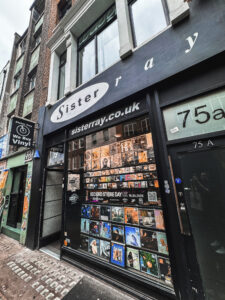
Record store in the SoHo neighborhood of London, UK
A vinyl record must be removed from its sleeve, placed on a turntable, and handled with care. A CD comes with packaging, liner notes, and artwork. Even a cassette tape requires a deliberate sequence of actions that many of us remember from childhood. These are not necessarily better ways to consume music. They’re different ways to experience it.
The physical object creates a ritual. It asks us to make a choice, handle something tangible, and give it our attention.
And imperfections can become part of the experience. An old record may have an occasional pop or crackle. A signed poster may carry an uneven signature. A vintage video game box may show the wear of decades. Those characteristics can become part of an object’s history rather than flaws to eliminate.
A perfect digital reproduction can provide access to content. A physical object can provide a connection to a particular person, place, or moment. For many collectors, the intentional act of searching, choosing, acquiring, and caring for something is inseparable from its value.
Sometimes the value isn’t in having the most perfect version of something. It’s in the experience of making it your own.
When everything can be perfect
For decades, technology has helped organizations eliminate friction and imperfections. Messages became more consistent, production more polished, and distribution more efficient.
AI may accelerate that process dramatically, making highly customized, beautifully produced content accessible to almost anyone. But when perfection becomes abundant, it may also become ordinary. The things that cannot easily be reproduced become more interesting: a spontaneous conversation, a performance that unfolds differently each night, a handmade object, or a discovery made by chance.
Human experiences are often messy, unpredictable, and imperfect. That may be precisely what makes them memorable.
Recent research offers a related perspective. The 2026 Edelman Trust Barometer Special Report(opens in new tab) found that 54% of respondents felt a connection with people who used the same brands they did, eight percentage points higher than five years earlier. The research also emphasized the role of brands in building trust and shared identity.
Brands like Delta Air Lines, Hilton, and TUMI approach this in different ways. Delta rewards frequent travelers with recognition and special access. Hilton offers personalized hospitality and experiences beyond the hotel stay. TUMI allows customers to personalize luggage that accompanies them on their journeys. Each creates opportunities for customers to develop a relationship with a brand that extends beyond the basic transaction.
Of course, there’s a distinction between making someone feel recognized and simply categorizing them within a loyalty program. The most meaningful brand experiences give people something personal to enjoy, remember, and introduce to others.
Established brands don’t have to abandon their heritage to remain relevant. A heritage brand is a company that places its long history, traditions, origin, and curated past at the core of its identity and marketing strategy. In fact, familiarity can become an advantage when a company gives people an unexpected way to experience it.

The recognizable Cheez-It brand
Think about Cheez-It. Its familiar orange crackers and packaging are recognizable to generations of consumers. Yet imaginative collaborations, unusual products, and limited-time experiences can make people look at that familiar brand differently.
I’ve explored this previously in my post, Unleashing the Power of Story with Limited Brand Experiences, using the Cheez-It Stop as an example of how an everyday product could become the center of an unusual experience. The Cheez-It Stop transformed something familiar into a destination worth discovering. The brand was already known. The new context created curiosity and gave people a reason to seek it out.
This is particularly interesting because it doesn’t require reinventing the original product. A heritage brand can retain the qualities that made it recognizable while experimenting with new ways for people to encounter it.
The same principle applies to collaborations involving fashion, music, gaming, and entertainment. Two recognizable identities come together to create something neither could have offered in quite the same way alone.
Heritage creates recognition. Collaboration creates rediscovery.
Big brands still matter. But increasingly, their opportunity may come from giving people new reasons to experience something familiar in a personal way.
- A polished campaign can generate awareness.
- A trusted recommendation can create interest.
- But a meaningful experience can create lasting attachment.
As AI makes personalized marketing increasingly easy to produce, genuine recognition may become even more valuable. Customization changes what someone receives. Participation changes what the experience means to them.
Designing for discovery
I find these ideas particularly interesting from a world-building and scenario-design perspective.
A well-designed world doesn’t reveal everything immediately. It provides enough context for people to understand where they are, while leaving opportunities to discover something through their own actions.
Games have understood this for decades. Hidden levels, Easter eggs, unlockable characters, secret passages, and rare items reward curiosity and exploration. Players exchange discoveries, develop shared language, and build communities around what they uncover.
Sometimes the most memorable part of a game isn’t what the designer explicitly presents, but what players discover for themselves. And when someone discovers a secret in a game, they’re often eager to show a friend.
I’ve explored this relationship between storytelling and participation in Breaking the Magic Circle: When Stories Step Into the Real World(opens in new tab). When Ferris Bueller speaks directly to the audience, he lets us in on the joke. We become co-conspirators rather than passive observers.
That’s part of the appeal of discovery. Knowing something changes our relationship with the experience, and sharing it allows someone else to become part of the story.
I’m have been seeing this happen in a Minecraft Build event I support annual in Washington, D.C., for more than 80 middle and high school students in Washington, D.C. The event brings together students to imagine solutions to real urban problems, including affordable housing, green infrastructure, and connected communities.
What makes the event interesting is the combination of something familiar with something unexpected. Many of the students already know Minecraft. They understand its world, its blocks, and its possibilities. But a game jam introduces a different way of experiencing it. Instead of simply playing, they become designers. They collaborate under time constraints, respond to challenges, make decisions, and present their ideas to others.
The platform is familiar. The purpose is new.
I explored the creative potential of these collaborative challenges in my earlier post, What Is a Game Jam?, where participants use a limited period of time to develop something together. The constraints become part of the creative process.
Minecraft is already one of the world’s most recognizable gaming brands. But bringing it together with education, community organizations, and real-world urban challenges gives students an opportunity to see something they know in an entirely different way. And the students leave with something more than familiarity with Minecraft. They have a story about what they created, the people they worked with, and the possibilities they discovered.
That’s the opportunity for heritage brands and established platforms. The recognizable world provides a common starting point. A new experience changes what people can do within it.
- A museum might create experiences that reward returning visitors.
- A workshop could include scenario elements revealed through participant choices.
- A conference might create opportunities for unexpected conversations rather than relying entirely on polished presentations.
Emerging technologies, including AI, can make such experiences increasingly adaptive. A digital environment could respond to a participant’s interests, previous choices, or actions, creating a journey that isn’t exactly the same for everyone.
But personalization alone isn’t enough. A system that inserts someone’s name into a message isn’t necessarily meaningful. The experience needs to reward attention, create agency, or provide a connection worth remembering. And ideally, it gives someone a reason to bring another person along.
The difference between scarcity and belonging
There is, of course, a potential downside to all of this. Scarcity is easy to manufacture. Genuine connection is much harder.
A company can artificially restrict supply, invent a waiting list, or create a members-only experience. Those techniques may generate short-term demand, but they don’t automatically create loyalty. In some cases, they produce frustration or communities where the ability to spend money matters more than shared enthusiasm.
There’s also a tension between growth and intimacy. A community that begins as a small, distinctive gathering may lose some of its character when the experience becomes widely commercialized. The temptation is to scale everything.
But perhaps the lesson isn’t that every experience should become bigger. Some experiences become valuable precisely because they remain personal, unusual, and rooted in genuine relationships.
The best version of “if you know, you know” isn’t about keeping people out. It’s about having something you care enough about to invite people in.
That’s why the In-N-Out secret menu is such an interesting example. The menu isn’t actually secret, and anyone can participate. What matters is the pleasure of discovery and the opportunity to share it. Likewise, a limited-edition collaboration may attract attention through scarcity, but its lasting appeal depends on what it means to the people who experience it.
A small charm on a backpack can signal a shared interest. A collectible can spark a conversation. A familiar game can become the foundation for an unexpected collaboration. These are opportunities for recognition, not simply consumption. Exclusivity can create curiosity, but generosity builds community.
The value of being there
There’s something wonderfully paradoxical about our increasingly digital world. As technology makes it easier to create and distribute content to millions of people, unique experiences may become more meaningful precisely because they cannot be replicated at that scale.
AI can generate an advertisement, compose a convincing message, or help create a beautiful image. It can also open exciting possibilities for interactive and personalized experiences, but being present for a particular moment, contributing to an outcome, discovering something unexpected, or sharing an experience with others carries a different kind of value.
Perhaps the future of marketing isn’t about creating more perfect messages, but designing experiences that leave room for discovery, participation, and human connection. In a world where almost anything can be replicated, the things that cannot be repeated exactly may become the most meaningful.
The real value isn’t simply in what we receive. It’s in the story of how we came to experience it, how we make it our own, and the people we bring along.
What’s something you love that you couldn’t wait to introduce to someone else? Because part of the joy of knowing is helping someone else know, too.
If you know, you know.