
Sub-Total: $0.00
The Human Ecotone, At the Edge of What We Know
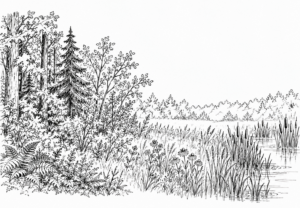
In ecology, some of the most interesting places are the edges.
Where a forest meets a meadow, freshwater meets saltwater, or one type of forest transitions into another, a boundary or transitional zone forms. Ecologists often use the term ecotone for these areas, and the edge effect to describe the changes in ecological conditions and interactions that occur around them. Ecotones can bring together species, resources, and environmental conditions from adjoining ecosystems.
But edges are not automatically better. They can also be disruptive. Conditions can change abruptly across boundaries, creating opportunities for some species and stress for others. The important idea is not simply that an edge creates diversity. It is that when different systems meet, something changes.
I see a similar phenomenon at the beginning of almost every meeting with new people. We deliberately bring together people from different organizations, professions, ranks, countries, disciplines, and experiences. A military planner may sit beside an intelligence analyst. A logistician may work with a technologist. An operator may meet a policy expert. In multinational exercises, even basic assumptions about language, authorities, decision-making, and risk can differ. We have created a human ecotone. And just like its ecological counterpart, the first result is not necessarily harmony.
Forming, Storming, Learning
Psychologist Bruce Tuckman famously described group development through the stages of forming, storming, norming, and performing. His original 1965 work described a progression in which groups first orient themselves, then encounter conflict, begin developing cohesion and shared norms, and eventually become better able to focus on the task.
The first morning can be polite. People introduce themselves, listen to the opening brief, and quietly assess the room. Everyone is still figuring out who knows what, who has authority, and how the group is going to work. Then it begins. Someone questions an assumption. Someone says, “That isn’t how we would actually do this.” Authorities become unclear. Organizations discover that they use the same words differently. Someone realizes that a critical piece of information they assumed another organization possessed does not actually exist. The group begins to storm. That can feel like the the event is going badly, though it may actually mean the learning is finally starting.
Friction Is Part of the Design
Exercises are often designed around problems in technology, plans, policies, authorities, or processes, but underneath all of those is another system being tested: the collection of people we have assembled to solve the problem.
A perfectly harmonious group may move quickly but may also carry shared assumptions forward without examining them. A diverse group introduces more boundaries into the room. Different expertise creates an edge between disciplines. Different organizations create an edge between cultures. Different levels of experience create an edge between mental models. Those edges create friction, but they also create possibilities.
The value does not come from diversity by itself; it comes from interaction across the edges.
Push the Player to the Edge
There is another edge we deliberately create in exercises: the edge of the player’s own capability.
A good scenario should not simply ask participants to demonstrate what they already know. It should move them far enough beyond the familiar that they have to reconsider assumptions, combine knowledge in new ways, or develop a capability they did not possess when the exercise began.
That edge might be technical. A player encounters a system failure they have never seen before. It might be organizational, where two commands discover that their authorities overlap in ways nobody has fully worked through. It might be cognitive, where the scenario removes the option everyone expected to use and forces the group to find another path. Or it may simply place someone in a situation where yesterday’s answer no longer works.
This connects to an idea I explored in my earlier piece, Your own Hero’s Journey in 12 steps. The Hero’s Journey is not just a storytelling structure. It can also be a way of thinking about the challenges and changes we encounter ourselves. We begin in an ordinary world, encounter something that pulls us beyond the familiar, cross a threshold, face tests and setbacks, learn from allies and adversaries, and ideally return with new knowledge or capabilities. In that earlier piece, I argued that the same structure can be applied to challenges in our own lives.
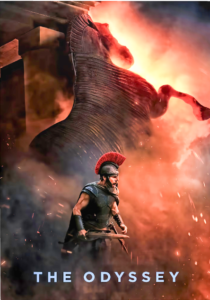
“The Odyssey” movie poster
Few stories demonstrate that pattern better than Homer’s Odyssey. Odysseus does not simply travel from Troy back to Ithaca. His journey is defined by everything that prevents him from getting there: storms, shipwrecks, the Cyclops, Circe, the Sirens, temptation, loss, bad decisions, and the consequences of earlier choices. The destination matters, but so do all the things that happen along the way. Christopher Nolan’s recent film The Odyssey makes that idea strikingly visual. Released in July 2026, the film translates Homer’s journey into a succession of large-scale physical and mythological trials, putting the difficulty of the voyage itself at the center of the experience. Universal describes it as Nolan’s adaptation of the ancient epic, shot for IMAX and released theatrically in 2026.
That is also what a good exercise scenario can do. We are not creating obstacles merely to make the game harder. We are designing a journey through challenges. A communications failure may expose an assumption about information sharing. A resource shortage may force prioritization. An adversary action may invalidate a comfortable plan. A policy constraint may reveal that what is operationally desirable is not actually possible. A decision made early in the exercise may create an unexpected problem several turns later. Each event should reveal something; the challenge becomes meaningful when the player has to adapt.
Like Odysseus, the participant should not reach the end exactly as they began. Ideally, they have discovered something about the environment, the organization, their teammates, or themselves. Perhaps they learned that an existing plan does not survive contact with reality. Perhaps they discovered an authority they did not know existed. Perhaps another participant changed how they understood the problem. Or perhaps they realized that a trusted assumption was wrong.
The Storm Is Data
There is a natural temptation at the beginning of an exercise to make everything run smoothly. We want participants to understand the scenario. We want the technology to work. We want the agenda to stay on schedule. Facilitators instinctively try to resolve confusion.
Some confusion certainly should be eliminated. Participants should not spend an hour struggling with poorly written instructions or malfunctioning technology, but we should be careful not to remove the productive friction. If different organizations interpret the scenario differently, that may be important. If two experts disagree about what should happen next, that may be important. If participants discover that they have incompatible assumptions about who has authority to make a decision, that may be exactly what the exercise was designed to uncover. The storm is data.
Instead of immediately resolving every disagreement, facilitators can ask why participants see the problem differently. What assumption are they making? What information would change the decision? Who believes they have authority? What would happen if this disagreement occurred during the real event? Those conversations expose the hidden architecture of the system.
From Edge to Ecosystem
Eventually, something interesting often happens. People begin to understand not only what other participants know, but how they think. Participants stop speaking only for their organizations and begin solving the problem as a group. The room moves from forming and storming toward norming and, sometimes, performing. The exercise has created a temporary ecosystem, and that may be one of the most valuable outcomes we produce.
We often measure exercises by observations, decisions, or after-action reports. Those artifacts matter, but another product may be harder to quantify: people who did not previously understand one another have developed a shared mental model and have learned where the organizational edges are and may also have learned something about the edges of their own abilities.
In ecology, an edge is not simply a line separating two environments. It is a place where those environments interact. The same may be true of organizations and of people. We should deliberately create conditions where their ideas collide, adapt, and eventually connect.
Because sometimes the most interesting things grow at the edges.