
Sub-Total: $0.00
Making Games at Grandma’s: Where Rules Came From
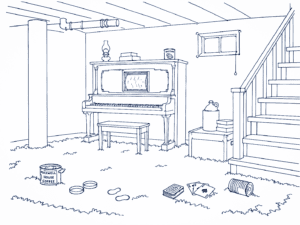
My grandmother had a deck of playing cards, a scattering of old toys from decades of older kids play, and a basement full of things that were always about something else.
Tin cans. Rubber bands. A player piano that didn’t play. A green shag carpet that looked like grass.
We made games out of all of it.
The Rules of the Thing
The interesting part was not the games themselves. Most would have been incomprehensible to anyone who had not been there when we invented them. The interesting part was making the rules.
One of my siblings would propose a rule. Someone else would immediately find the loophole. The rule would be revised. An exception might be argued over before being formally adopted.
The game evolved across the afternoon until it was genuinely playable. Not necessarily fun for everyone, but playable. Without knowing it, we were practicing game design.
More importantly, we were learning that rules are constructed things. They come from somewhere. They serve a purpose. They can be challenged, revised, or replaced when they stop producing the experience the players intended.
Of course, changing them required a good reason and enough agreement from everyone else around the basement floor.
Entering the Magic Circle
I have written before about the Magic Circle, the invisible boundary players cross when they agree to enter a game.
Inside that circle, ordinary objects can become something else. A jar lid becomes currency. A rubber band becomes a boundary. A shag carpet becomes a landscape or a road to somewhere important. The objects do not change, but our agreement about them does.
The same is true of the rules. For the game to work, everyone has to accept that certain actions matter, certain boundaries exist, and certain outcomes follow from certain choices. That shared agreement creates the game.
Our magic circle was not drawn on the floor. It was created through imagination, argument, and eventually consensus. We stepped into it whenever we agreed that the things in front of us were no longer merely things from my grandmother’s basement; they had become a world.
The Thing No One Taught
Schools teach us to follow rules. They measure our ability to perform within rule-governed systems. They rarely teach us to notice that those systems were designed.
We are not often asked why a rule exists, what behavior it encourages, who benefits from it, or how the outcome might change if the rule were different.
My grandmother’s basement taught me to ask those questions because there was no curriculum. No adult deliberately created a lesson in systems thinking or game mechanics. The environment simply provided the right conditions for a few siblings on a weekend trip to Grandma’s.
We had time and materials that had not been designed for any particular purpose. Most importantly, there was no one standing over us explaining the correct way to use them. That is a fairly precise definition of creative freedom, and it is rarer than it sounds.
When my brother and I were a bit older, we created our own version of Dungeons & Dragons. We played the original version with our older cousin but could not afford the books, so we made up our own version.
What It Made
I think a significant part of how I approach game and exercise design began during those afternoons.
Rules are made. They can be tested. They can be revised. The purpose of a rule is not merely what it says, but what it produces when people interact with it.
In an exercise, every rule shapes the world the players experience. It determines what they can see, which decisions matter, what consequences follow, and what kinds of behavior the environment rewards.
Designing the rules is therefore not administrative work, it is world-building.
The artifact I carried away from my grandmother’s basement was not any particular game, as I cannot remember most of them, assuming they ever had names. The artifact was the practice of making.
It was the understanding, absorbed long before I had words for it, that you do not have to wait for someone to hand you an idea; sometimes you can make one from whatever is in the basement.