
Sub-Total: $0.00
Every Portal Changes the Rules

A portal is more than a doorway. It marks the moment familiar rules stop being enough.
Lucy steps through a wardrobe and finds a world already in motion. Neo takes the red pill and chooses a truth he can’t unknow. Alice passes through a looking glass. Phil Connors wakes up to the same day again. Each crossing changes what the character must do next.
That’s true beyond stories, too. Some thresholds ask us to get our bearings. Others ask us to commit, learn a system, or break a recurring pattern. Recognizing the kind of portal we’re facing can help us understand the challenge on the other side.
The discovered portal
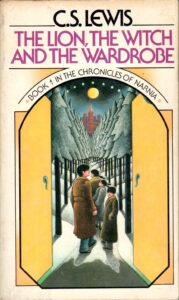
Book cover for C.S. Lewis’s book “The Lion, The Witch, and the Wardrobe”
Both Narnia and Wonderland begin with a discovery. In C.S. Lewis’s 1950 novel The Lion, the Witch and the Wardrobe, Lucy Pevensie steps through a wardrobe and finds a world she never knew was there; later, her siblings follow her inside. In Lewis Carroll’s 1865 book Alice’s Adventures in Wonderland, Alice follows the White Rabbit and tumbles into Wonderland. A discovered portal is something you didn’t know was there until you found it, or it found you. The world on the other side is already fully formed, operating by its own rules, independent of the protagonist’s arrival. The challenge is orientation: you have to learn those rules while navigating the world’s dangers. In life, a discovered portal might be an unexpected opportunity, a diagnosis that reframes everything, or a conversation that opens a door you didn’t know existed.
The chosen portal
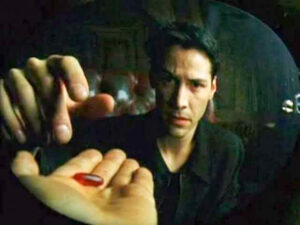
A screenshot of Neo considering taking the red pill in The Matrix.
The Matrix‘s red pill. The wardrobe, once Lucy tells the others. The chosen portal is one you go through knowing, at least in principle, that you can’t un-go-through it. The challenge is commitment, the willingness to accept that you won’t be able to return to the version of yourself that didn’t know what’s on the other side. In The Matrix, the character Morpheus offers Neo a choice between the red pill and the blue pill. Taking the blue pill lets him wake up in his bed believing whatever he wants, remaining in the comfortable illusion of the Matrix. Taking the red pill means staying in “Wonderland” to see the harsh, painful truth of the real world outside the machine-controlled simulation. Career changes are often chosen portals. So are marriages, and certain kinds of therapy, and the decision to start something you can’t abandon without real cost.
The digital portal
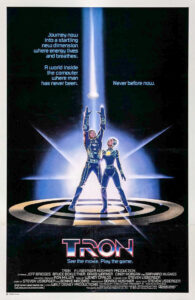
1982 film poster for Tron.
The digital portal appears in Tron, The Matrix, and Sword Art Online, each in a different form. In Steven Lisberger’s 1982 film Tron, programmer Kevin Flynn is pulled inside a computer system where programs take human form and the Master Control Program controls the world. In The Matrix (1999), Neo discovers that the reality he knows is a simulation designed by machines, and must learn to see and challenge the code beneath it. In the 2012 Sword Art Online series, players enter a virtual-reality game created by Akihiko Kayaba, then discover they are trapped inside it and must clear the game to escape.
The digital portal is a crossing into a rule-governed system designed by someone, even if you don’t know who or why. The challenge is understanding its logic: the rules are consistent, and once you learn them, you can navigate the system. The risk is that those rules may not have been designed with your interests in mind. A new organization can be a digital portal, as can any highly structured institution: the military, academia, or a large corporation. The rules are real. They serve someone’s purposes. Figure out whose.
The time loop
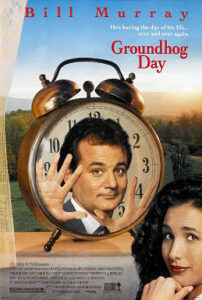
1993 film poster for the film Groundhog Day.
Groundhog Day, Edge of Tomorrow, and Palm Springs each trap their characters in a repeating day, but the loop tests them in different ways. In Harold Ramis’s 1993 film Groundhog Day, cynical weatherman Phil Connors keeps waking up on February 2 in Punxsutawney, forced to relive the same day. In Edge of Tomorrow (2014), soldier William Cage dies in battle and wakes up at the start of the same day, using each repetition to learn how to fight an alien invasion. In Palm Springs (2020), wedding guests Nyles and Sarah find themselves reliving the same day in the desert, and must decide what to do with a life that seems to have no consequences.
The time-loop portal is one where you’re not moving forward. You’re being asked to experience the same situation differently, repeatedly, until something changes. The challenge isn’t crossing the threshold. You’re already through. It’s recognizing the loop and figuring out what it would take to exit. In life, the time loop is a repeated pattern: a relationship that goes the same way every time, a career move that produces the same outcome at a different company, or an argument that never resolves.
What kind of portal are you at?
The portal type helps you see what the moment is asking of you. A discovered portal calls for orientation. A chosen portal calls for commitment. A digital portal calls for systems thinking. A time loop calls for pattern recognition and change.
Why pay attention to the portal? Because naming the kind of threshold you’re facing can turn uncertainty into a clearer next step. You may need to learn a new world, make an irreversible choice, understand the system around you, or stop repeating a familiar pattern.
Think about a threshold in your own life. What kind of portal are you facing, and what does it ask you to do next?