
Sub-Total: $0.00
Why the Creak Becomes a Creature
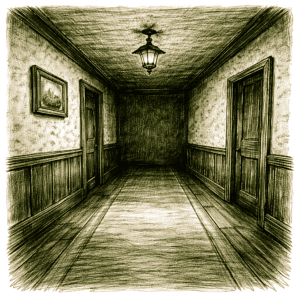
There is a specific kind of silence that only exists at night.
It is not peace. It is a blank page.
Then the house makes a sound; a small creak, the soft complaint of wood and temperature and time. A normal thing. A boring thing.
And yet, my mind immediately begins casting.
Not just, “Something moved.” Not even, “The house is settling.”
No, it goes straight to: Something is here.
It is amazing, really, how quickly a single noise turns into a presence; how fast the brain upgrades physics into mythology. A creak becomes a creature, not because the evidence demands it, but because the human mind is a story engine that hates ambiguity. We do not just perceive the world; we narrate it.
We are the species that hears a sound in the dark and immediately starts writing.
The monster is the brain’s shortcut
A creak is uncertain. Uncertainty is expensive.
It is hard to hold a question mark in your nervous system. A question mark has no edges; it has no plan. It just sits there, hovering, asking for attention every few seconds like a needy notification.
So we do what humans do best; we give it a face.
We take the fog of “I don’t know” and compress it into a single, trackable shape. If it is a creature, then it is one thing, in one place, with one set of rules. It can be avoided. It can be fought. It can be understood.
A monster is not proof of danger; it is proof that the brain wants the world to be navigable.
This is not a modern flaw. It is ancient software. Pattern detection kept our ancestors alive. If the grass moved, you assumed it was something with teeth. The cost of being wrong in one direction was embarrassment. The cost of being wrong in the other direction was becoming lunch.
So yes, our brains are biased toward monsters. They are also biased toward survival. Sometimes those two are the same thing.
We are trained early: good and evil as the first game
When I think about where this starts, I do not just think about creaky houses and scary movies. I think about childhood.
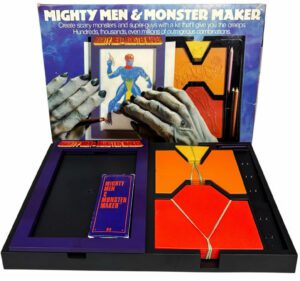
Tomy’s “Mighty Men & Monster Maker” drawing toy from 1979
I think about my brother’s Tomy “Mighty Men & Monster Maker” drawing toy from 1979; a crank-and-stencil character machine from the pre-digital age that literally taught you how to make a story on demand: choose the parts, build the face, roll it through, and suddenly you had a hero to cheer for and a monster to blame. My generation’s K-Pop versus demons.
Kids do not play because they are avoiding reality. Kids play because they are practicing reality.
Those toys were not just entertainment; they were training wheels for meaning. They taught us that the world is full of forces; some protect you, some threaten you, and the story makes it possible to tell them apart.
And once you learn that framework, you start applying it everywhere. The brain loves a binary. It loves a cast. It loves a simple map of “safe” and “unsafe.”
Religion reinforces this early. Film reinforces it later. Culture stacks the same lesson on repeat: there are heroes, there are villains, and the unseen has intentions. Even when we grow up and become sophisticated adults who pay taxes and pretend we are immune to cartoons, the old patterns remain. They just get better costumes.
The monster evolves, but the function stays the same.
Why Scooby-Doo is secretly comforting
This is where Scooby-Doo deserves more respect than it gets.
Every episode is a small ritual of fear and relief. A town is haunted. A monster appears. Everyone panics. Then the gang does the most radical thing you can do in a scary situation; they investigate.
They turn dread into clues.
And at the end, like clockwork, the monster is exposed. The mask comes off. The glowing eyes become a guy with a bad plan. The supernatural collapses into motive.
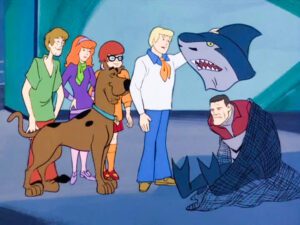
Screenshot of the Scooby Doo team unmasking a monster
It is always a letdown, and that is the point.
A solvable mystery is easier to process than an unknowable terror. A fake ghost is easier to live with than a real one. If the monster is supernatural, then the rules are broken and you are powerless. If it is a person with incentives, then the world still makes sense. It can be confronted. It can be stopped. It can be explained.
Scooby-Doo is basically weekly exposure therapy with snacks. Fear rises; logic shows up; the nervous system exhales.
The unmasking is not just a twist; it is a promise: the world is still legible.
The Wizard of Oz and the man behind the curtain
The Wizard of Oz hits the same note, but it lands deeper because it is not just about a monster. It is about authority.
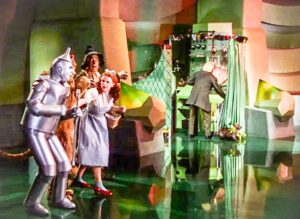
Scene from “The Wizard of Oz” where the curtain is pulled back to reveal not a great and mighty Oz but something less powerful.
Oz presents power the way childhood often experiences it: huge, mysterious, booming, unquestionable. A floating head; a voice like thunder; the sense that someone unseen controls everything.
Then the curtain is pulled back.
And the great and terrible presence becomes a small person working a machine.
Again; it is a letdown. Again; that is the mercy.
The reveal does not remove the journey Dorothy took. It does not erase the feelings. It does not make the fear silly. It simply returns power to the human scale. It says: the thing you thought was cosmic may be mechanical. The thing you thought was fate may be a lever. The thing you thought you could never understand might be understood.
There is comfort in that. Not because the world is simple, but because it is not purely magical in the worst way; not arbitrary; not untouchable.
Why we keep making creatures
So why does the creak become a creature?
Because the mind would rather be scared by something with a face than unsettled by something without one.
Because stories are how we compress chaos into meaning.
Because we are trained from early childhood to sort the world into good and evil, heroes and villains, safety and threat; and once you have that template, it becomes your default lens in the dark.
Because a fake ghost is manageable. A solvable mystery is merciful. The unmasking is a kind of emotional math that balances the equation.
And if I am honest, because part of us enjoys it.
We like the spike of fear when the hallway is too quiet. We like the idea that the world contains hidden rooms. We like the feeling of being on the edge of something. We just want the option to pull the mask off at the end and return to a world with rules.
The adult version of unmasking
The funny thing is that we never stop doing this. We just switch genres.
As adults, the “monster” is rarely a glowing phantom in an amusement park. It is a fear we do not want to name. It is a worry that has been hovering in the background for weeks. It is a problem big enough to feel supernatural. It is a person or institution that seems all-powerful. It is the sense that something is wrong, but you cannot find the source.
And the work, over and over, is Scooby-Doo work: gather clues; ask better questions; pull back the curtain.
Sometimes the monster really is real. Sometimes there is actual danger. But more often than we want to admit, the thing that is haunting us is a mix of uncertainty, imagination, and a lack of information; a creak that became a creature because the brain does not like blank pages.
The solution is not to shame yourself for being human.
The solution is to investigate.
Because the moment you name the fear, it stops being infinite. The moment you understand the mechanism, it stops being magic. The moment you pull off the mask, the creature shrinks back down to its true size.
And maybe that is the real comfort in all those stories.
Not that the monster was fake.
But that we were the kind of people who kept walking toward the sound anyway, flashlight in hand, ready to see what it really was.